

How To Upholster A Non-removable Chair Seat
I actually completed this chair months ago (some of you may even remember I posted a sneak peek on Facebook) and have just been waiting for some spare time to sit down and write the tutorial and share it already.
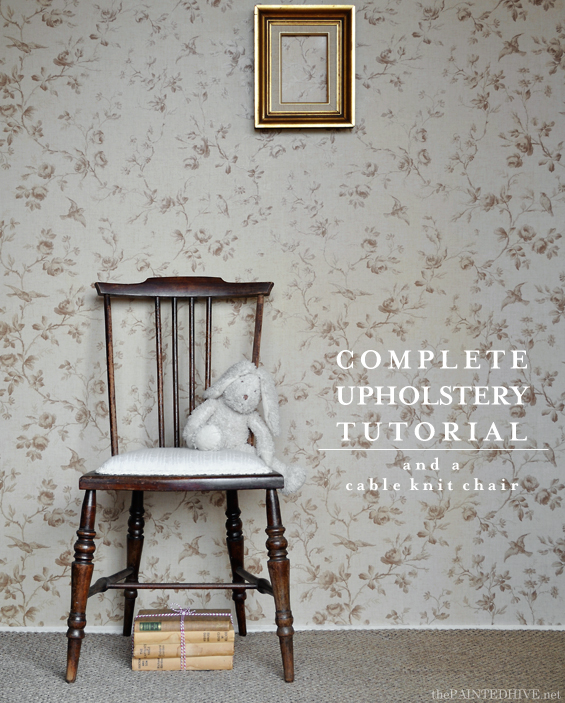
It's a sweetness little chair for Charlotte's room (yes, I will get that space completed – one twenty-four hour period). I picked it up from eBay for around $25 afterward a reasonably long search. Y'all see, I have this problem where I tend to envisage things I want – commonly things that don't exist – which means finding them mostly takes a really, really long time. Throw my disfavor for forking out big bikkies into the mix and information technology'due south near impossible. Anyhoo, when I finally spotted this chair I knew it was just right. The shape, calibration and patina, not to mention the price, were all perfect.
It'southward the same chair I featured (in its 'before' state) in my distressed table mail service…
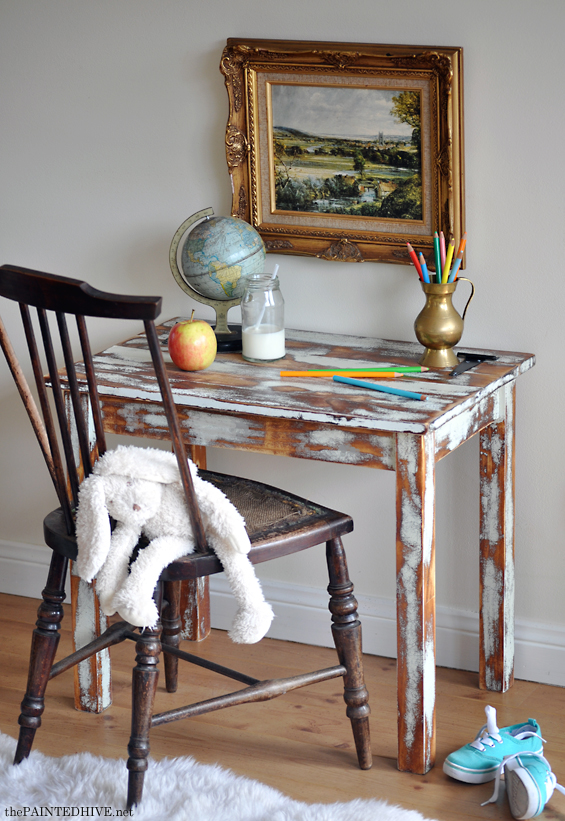
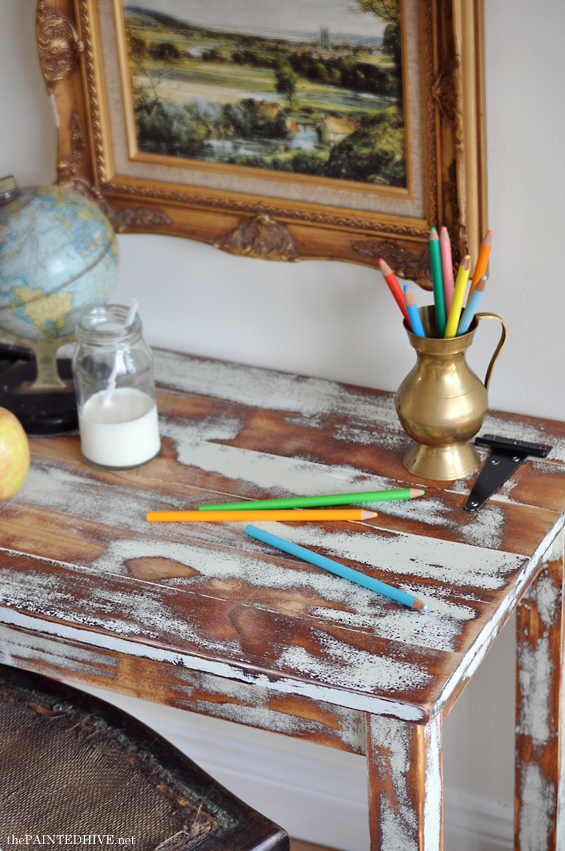
I must admit, after seeing these pics I vicious a flake in love with the raw unpretentious look of the incomplete upholstery and did consider leaving it every bit is, though the exposed hessian and remnants of gimp were but way too itchy and scratchy so a new seat comprehend information technology had to be.
This is the first time I've ever upholstered a chair without a removable driblet-in seat. I judge I must have felt kinda intimidated past the task, because this poor piffling chair sat neglected for over a yr. Turns out my trepidation was unwarranted. The project was actually pretty unproblematic and the result is surprisingly proper.
If, like me, you feel a little uncertain about the process of upholstering a chair with an attached seat pad, hopefully this tutorial will help shed some conviction inducing light.
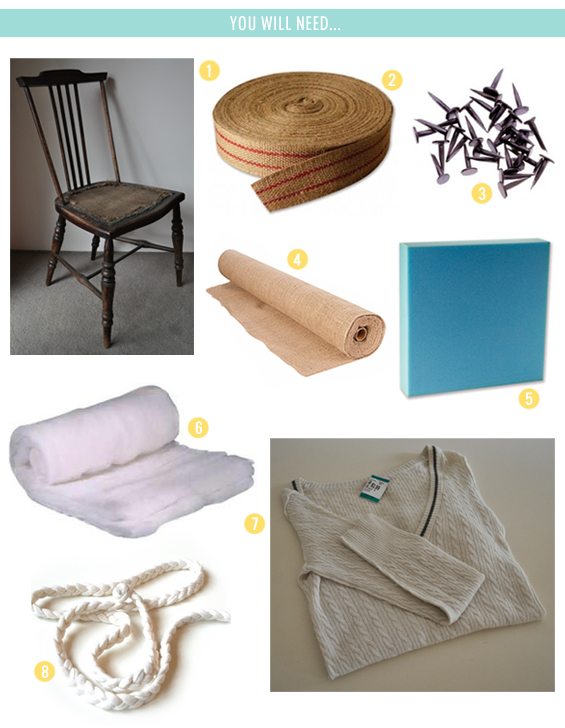
one Chair
Duh! As mentioned, I'thou using an antique kid's chair I picked upwards from eBay for $25.
2 Webbing
I'm using traditional jute webbing. Nowadays, you lot tin get it in nylon and other materials likewise.
3 Upholstery Tacks
I used 1cm (3/8″) long tacks. You could utilize a staple gun instead though given the thickness of the webbing I just prefer the secure hold tacks provide.
4 Hessian/Burlap
To deed equally a base of operations for the foam. Hessian is traditionally used though any strong woven fabric should suffice.
five Foam
I'm using mid-density 25mm (1″) foam.
6 Wadding/Batting
To soften the bend of the cream and assist muffle whatever inconsistencies.
7 Material
I usually go all practical when it comes to upholstery fabrics, especially where kids are involved, though in this example I kinda forgot most that. I wanted to apply a cable knit jumper – a cream i at that – so I just did. Of grade I've treated it with a material protector and have tried to persuade Charlotte to be somewhat careful though permit's face information technology, she's a child and it's her chair and then she tin utilize it as she likes (within reason of grade). I figure if it does get especially dirty, worn or stained I always know how to recover it – that's the power of learning to practice stuff yourself I guess :-) I picked up my pre-loved cablevision knit jumper for but $3.99 from Savers.
eight Trim/Complect/Gimp
For concealing the staples. I'grand using some actually lovely braided cotton which goes perfectly with the cable knit fabric. I found it at Spotlight for effectually $3 a meter.
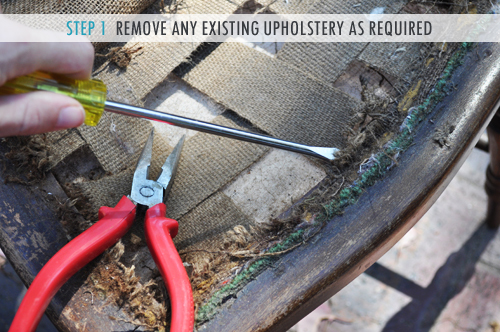
Footstep 1 Remove whatsoever existing upholstery as required.
In the case of my chair that meant the old webbing, hessian and glued-on gimp forth with a hundred million staples. Seriously. In many cases removing the existing upholstery can exist the well-nigh hard and time-consuming aspect of the whole project. If possible, avoid it if yous can. My webbing and hessian was merely a bit far gone to be saved.
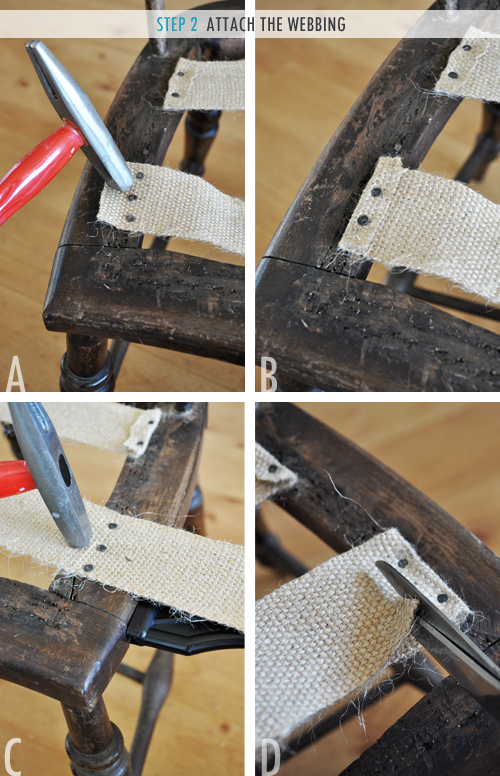
STEP ii Attach the webbing.
Y'all tin can exercise this in a few different means. This is how I went nearly it (you can read my previous tutorial for upholstering a driblet-in seat for a detailed explanation of a slightly different method).
A Cutting a strip of webbing around 20cm (viii″) longer than the width of the chair frame and tack information technology onto the seat. Take intendance to ensure you tack it as shut every bit possible to the inside edge. Retrieve, you demand frame infinite to attach the coming layers which as well demand to muffle the webbing.
B Fold the loose end over itself and tack again for extra strength.
C Pull the strip taut beyond the cavity (preferably using a spider web strainer – again, refer to my previous tutorial for more info) and tack once more in the parallel position on the reverse side of the frame.
D Fold the loose finish over itself and tack again then trim off whatsoever excess.
Repeat this process, weaving the strips, until you have something resembling this…
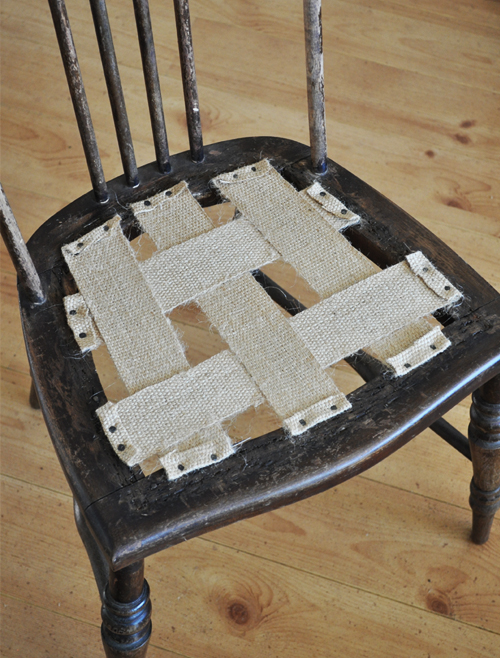
Of class, depending on the size of your seat, more or less strips may be required.
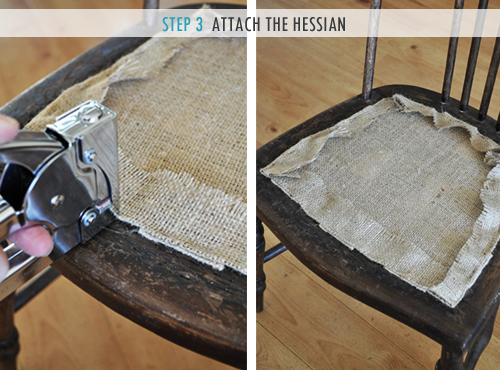
Footstep iii Attach the hessian.
Trim a piece of hessian around 5cm (2″) larger than the seat base. Position it on top then fold in the backlog earlier stapling it in place. This merely acts to fill the webbing gaps, making the base more comfortable and strong.
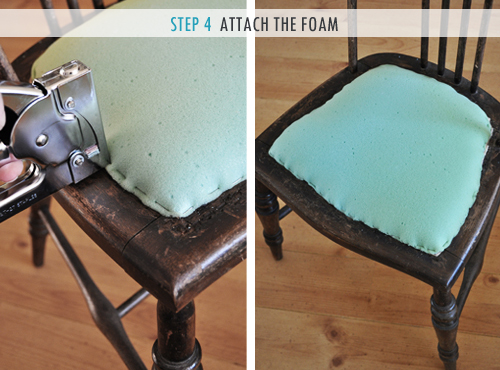
Step 4 Adhere the cream.
Trim your foam so it just covers the hessian. An electric pocketknife is by far the easiest tool for this task though if you don't take one precipitous pair of scissors will do. You may also find it easier to brand a template of the seat shape from card or paper first. Lay the foam in place and staple it on. I like to push button down the top edge of the foam, tucking the side underneath, to create a nicely rounded cease. Ensure you grab enough foam with the staples to avoid information technology pulling through (tearing) and lifting in the future.
Information technology will probably expect a little 'bobbly' (aye, that's a word) though provided the 'bobbles' aren't too inconsistent the wadding and textile should even everything out nicely.
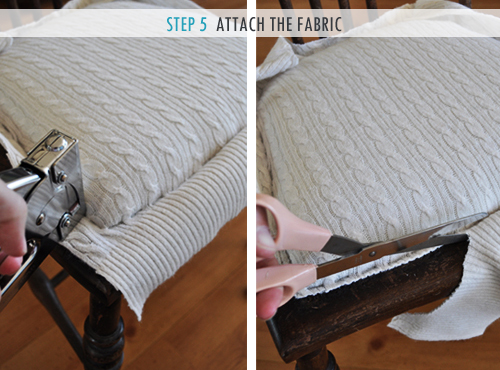
STEP 5 Attach the fabric.
Trim a piece of wadding around the same size as the foam and lay it on top. Trim your fabric so it comfortably covers the seat (having excess makes things a little easier) and lay it on top of the wadding. Brand sure it is straight and smooth. Neatly staple around the entire perimeter of the cream, pulling taut as required, then closely trim away whatever excess textile.
TIP: Using a thick and slightly stretchy fabric, especially a soft woven one, usually makes for a more smooth and consequent terminate. Thin and rigid fabrics show up imperfections much more obviously.
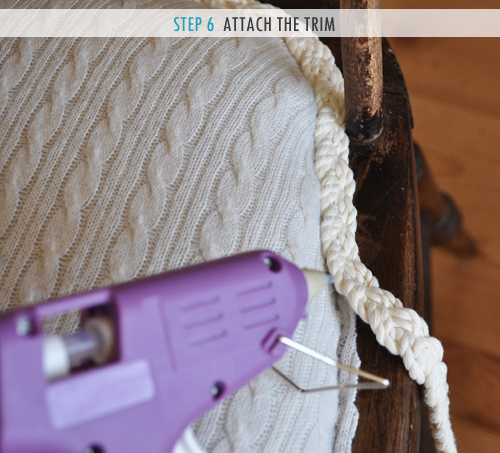
Pace 6 Attach the trim.
Choose an inconspicuous area or fundamental position to start in (I began center back). Fold a small portion of trim under itself (to muffle the exposed end and create a nifty loop) so attach it to the seat using hot glue. Press down hard to compress it slightly. Continue gluing and sticking until the entire edge of the fabric is concealed by the trim. When you reach the starting bespeak, cutting the trim leaving a footling excess to fold under once again, and then glue information technology down abutting the beginning…
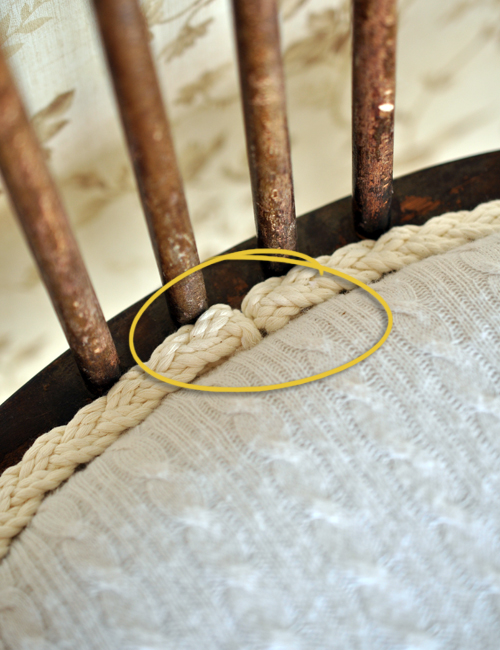
TIP: If, like me, you're using a braided trim that hands unravels, proceed the ends nifty by tightly wrapping a strip of articulate sticky tape around the expanse you need to cutting. When yous practice have to cut the braid, cut through the center of the record. This will go out merely a small portion of tape which will neatly hold the loose ends together though be barely visible in one case folded under.
Washed!
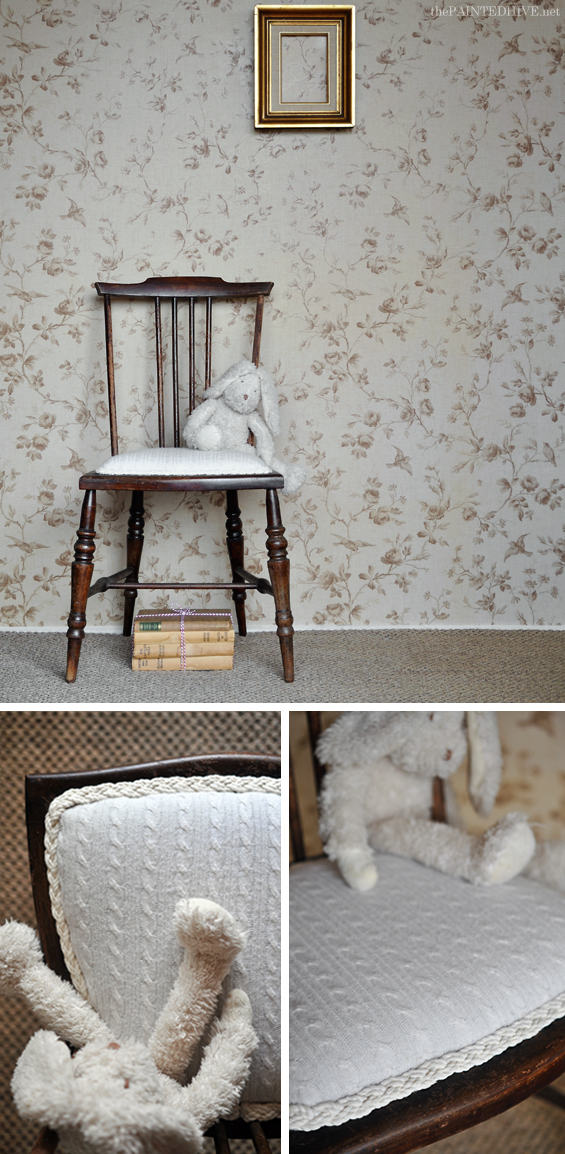
Like I said, hopefully this tutorial helps spark some motivation in those of you who have a chair like this languishing in a dark corner somewhere. Or, fifty-fifty better, maybe it might inspire a few of you to purposefully seek 1 out! In many cases chairs requiring some unproblematic re-upholstering can be picked up for super cheap.
Now, onto the side by side projection for Charlotte'southward room…

Yous have Successfully Subscribed!
Source: https://thepaintedhive.net/2014/08/how-to-upholster-a-chair-attached-seat-pad-method/
0 Response to "How To Upholster A Non-removable Chair Seat"
Post a Comment